



Discover why your BESS isn’t performing at peak capacity. Learn how analytics-driven O&M platforms prevent degradation, reduce downtime, and boost energy storage ROI.
BESS is Scaling but Operational Visibility Isn’t
Battery Energy Storage Systems (BESS) have evolved from auxiliary assets to mission-critical infrastructure in utility-scale renewable energy projects. This shift, driven by the increasing adoption of solar and wind power integration, has created an urgent demand for advanced BESS O&M platforms and battery asset monitoring software capable of optimizing performance across large-scale deployments.
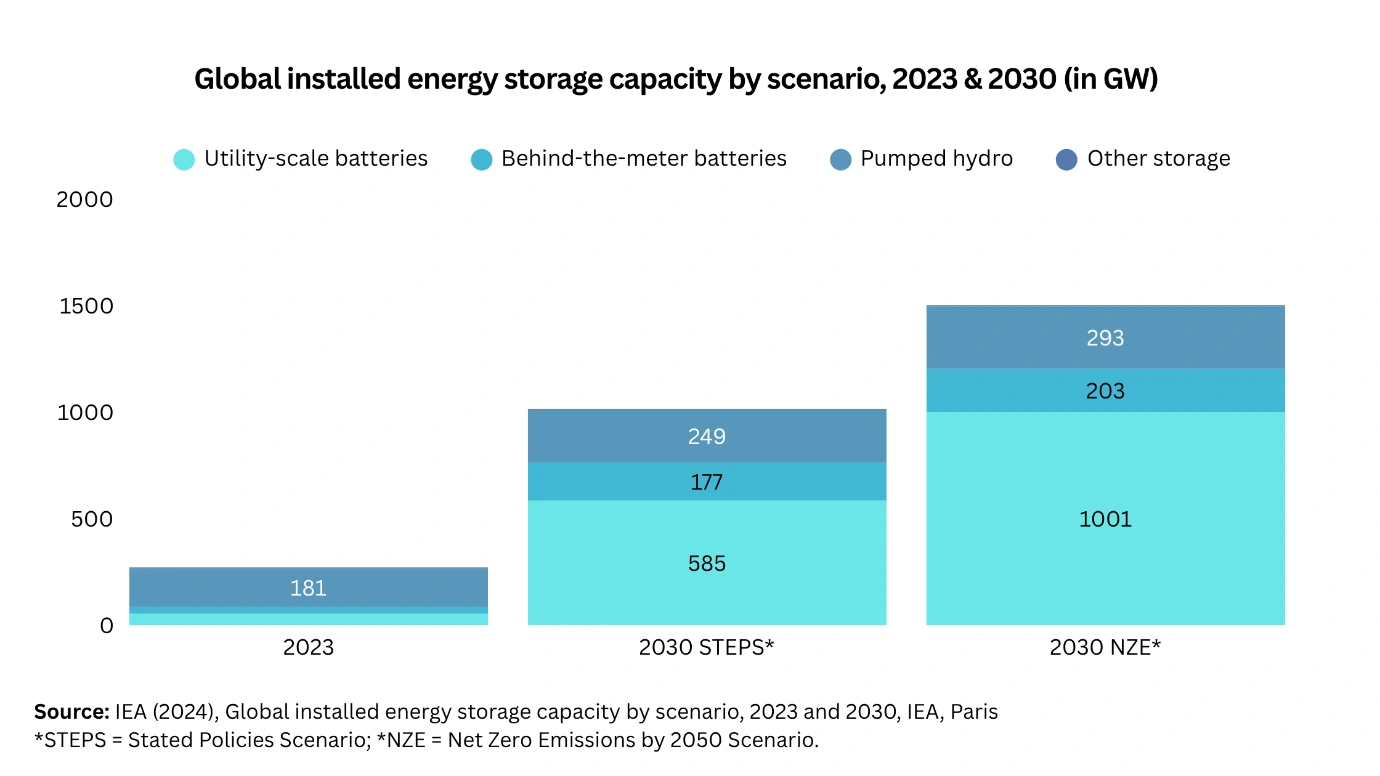
According to the International Energy Agency (IEA), global energy storage capacity is projected to grow from 181 GW in 2023 to over 1,000 GW under the Stated Policies Scenario, and to nearly 1,500 GW under the Net Zero Scenario by 2030. This exponential growth underscores the critical need for intelligent, analytics-driven BESS operations.
However, while deployment has accelerated, operational intelligence has not kept pace. Many operators continue to depend on static OEM dashboards, siloed SCADA telemetry, and fragmented CMMS tools. The result is a disconnect between installed capacity and performance output. Without deep, continuous analytics, BESS assets become underutilized, misconfigured, or prematurely degraded, directly impacting ROI and PPA compliance.
BESS Requires More Than Monitoring: It Demands Predictive Analytics and Control Loop Intelligence
The complexity of BESS operation goes beyond voltage and temperature thresholds. Operators managing utility-scale energy storage systems must track and optimize a matrix of interdependent parameters, including SoH (State of Health), DoD (Depth of Discharge), SoC (State of Charge), IR (Internal Resistance), C-rate efficiency, and temperature deltas across modules and racks.
Without a BESS-specific analytics layer:
- Charge-discharge patterns are not calibrated to aging curves
- Drift in string-level performance is not diagnosed in real time
- Peak-shaving algorithms are not aligned with actual cell behavior
- Fire and thermal runaway risks escalate due to delayed fault signatures
These blind spots persist because standard SCADA interfaces and EMS overlays do not capture degradation kinetics, operational stress maps, or predictive failure thresholds. Operators are forced to react post-event rather than pre-empt failure. And when cell-level anomalies surface in the form of harmonics or energy leakage, it’s often too late for mitigation.
Ignoring BESS Analytics Has Quantifiable Losses
According to McKinsey, the global utility-scale battery market is expanding at a CAGR of around 29 percent through 2030. This rapid growth is intensifying the need for scalable, high-accuracy asset analytics. As deployment accelerates, performance optimization cannot rely on static thresholds or basic monitoring tools.
Findings from NREL’s BLAST (Battery Lifetime Analysis and Simulation Tool) highlight that high-fidelity, real-time degradation modeling significantly improves capacity fade prediction accuracy compared to simplified linear models. High-fidelity degradation models simulate battery behavior by incorporating electrochemical responses to thermal conditions. They also factor in charge-discharge current profiles and depth-of-discharge ranges. This modeling approach enables early detection of capacity fade and imbalance trends that static performance monitoring may overlook.
A study by Pacific Northwest National Laboratory (PNNL) confirms that round-trip efficiency losses, if left unmanaged, it can materially affect the financial performance of BESS assets. In utility-scale projects, even a 1 percent drop in efficiency can erode profitability through diminished revenue from frequency regulation, energy arbitrage, and capacity market participation.
Early detection of thermal imbalances, string-level voltage deviation, and SoC drift is crucial. It helps prevent cascading failures, avoids warranty violations, and maintains regulatory compliance across markets with strict availability thresholds. AI-enabled BESS management is now a strategic necessity, bridging the gap between asset availability, predictive analytics, and maintenance, and energy market participation.
Curious how your BESS assets are performing? Run a free diagnostics preview with Apollo’s <b?>battery analytics platform and identify hidden performance drift, SoC calibration issues, and degradation hotspots-> Request a Performance Audit
The Role of a BESS-Native O&M Platform in Asset Reliability and Lifecycle Optimization
A generalized digital platform is insufficient to handle the operational complexity of BESS. What is required is a BESS-native O&M system engineered to provide:
- Module and rack-level SoH degradation analytics using electrochemical impedance modeling
- Predictive failure models leveraging supervised machine learning across environmental, electrical, and charge pattern datasets
- Thermal propagation risk detection through spatially correlated sensor anomaly detection
- Adaptive charging algorithms aligned with degradation minimization and arbitrage scheduling
- Automated CMMS integration for translating alerts into work orders with root-cause traceability
Apollo’s battery energy management system (BEMS) and BESS analytics platform integrates directly with OEM EMS layers, SCADA systems, and fire suppression diagnostics, ingesting time-series data and converting it into actionable degradation maps, predictive fault trees, and optimization recommendations.
Our battery energy management system creates a closed feedback loop between asset condition monitoring, predictive modelling, and maintenance execution, ensuring no degradation pathway or anomaly goes undetected or unaddressed.
Case Snapshot: EPC Operated 50 MW BESS Deployment
In a recent 50 MW deployment managed by an EPC in Southeast Asia, Apollo’s platform detected a string-level thermal anomaly at 14°C above mean operating thresholds within 22 hours of system integration. Pre-emptive shutdown of the affected rack prevented thermal propagation, while analytics triggered an auto-generated work order through the integrated CMMS.
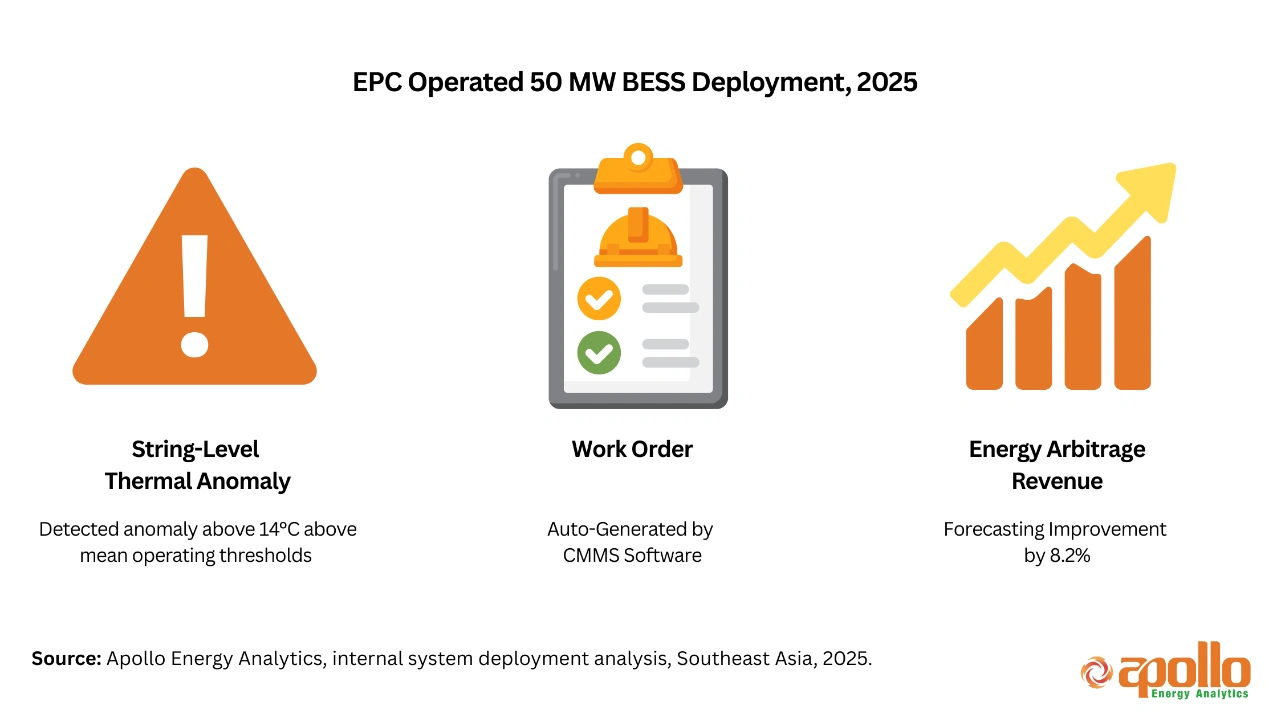
Simultaneously, Apollo’s degradation model recalibrated the site’s DoD settings in response to early signs of accelerated lithium plating in high-cycling containers, resulting in a projected 16 percent improvement in lifecycle extension.
Energy arbitrage revenue forecasting improved by 8.2 percent due to the correction of SoC calibration offsets that were previously undetected via the OEM dashboard.
Strategic Risk: The Cost of Operating in the Dark
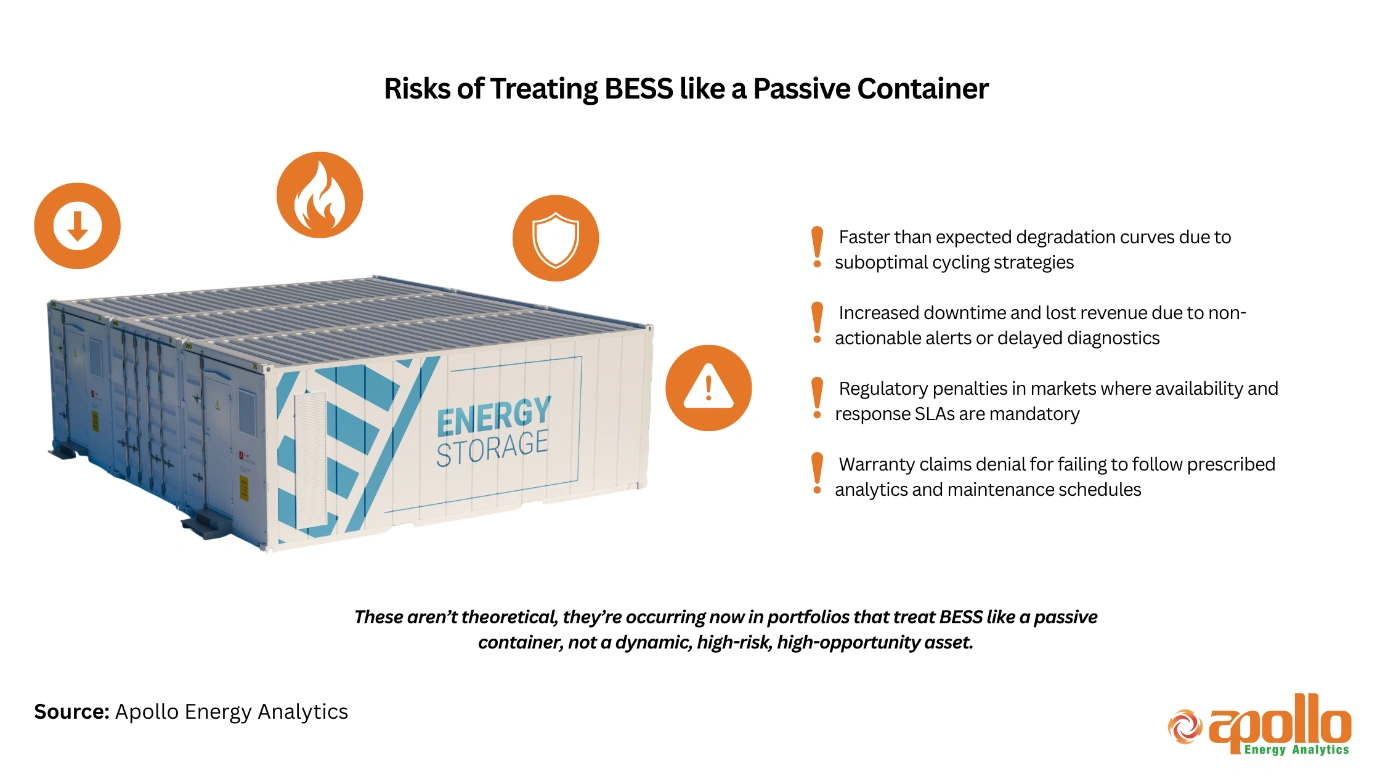
Organizations continuing to rely on manual monitoring, OEM-supplied dashboards, or post-failure analytics expose themselves to:
- Faster than expected degradation curves due to suboptimal cycling strategies
- Increased downtime and lost revenue due to non-actionable alerts or delayed diagnostics
- Regulatory penalties in markets where availability and response SLAs are mandatory
- Warranty claims denial for failing to follow prescribed analytics and maintenance schedules
- Insurance hikes following preventable thermal events or fire suppression failures
These aren’t theoretical, they’re occurring now in portfolios that treat BESS like a passive container, not a dynamic, high-risk, high-opportunity asset.
Apollo Energy Analytics: Purpose-Built BESS Intelligence
Our BESS O&M platform is engineered to serve as a digital twin of your energy storage infrastructure, combining:
- Asset-level performance diagnostics
- Predictive anomaly detection
- SoH degradation heatmaps
- Maintenance automation workflows
Whether deployed standalone or alongside existing SCADA and EMS tools, Apollo functions as the intelligence layer that transforms BESS from a CAPEX-heavy asset into a revenue-maximizing system with extended operating life and lower risk exposure.
Don’t Just Monitor. Operationalize.
Apollo is already powering performance gains across solar, wind, and storage portfolios. If your BESS strategy still relies on reactive alerts and lagging performance reports, it’s time to upgrade.
Ready to Explore? Book a Demo to see how Apollo predicts, prevents, and improves, with actionable insights tailored for your portfolio.
Have Questions? Reach Us at contact@apolloenergyanalytics.com



Leave a Reply