




Renewable Momentum in India
India is in the midst of an unprecedented renewable energy acceleration. According to the Ministry of New and Renewable Energy (MNRE), as of May 2025, the country added approximately 17 GW of renewable capacity, with solar contributing 12,970 MW and wind adding 3,129 MW. Rajasthan led with a 33% share in new capacity additions. This has pushed India’s cumulative non-fossil capacity to an impressive 226.7 GW. Analysts predict that India could add up to 30 GW of renewable capacity by the end of 2025, up from 28 GW in the previous year. This expansion signals a paradigm shift in India’s energy mix.
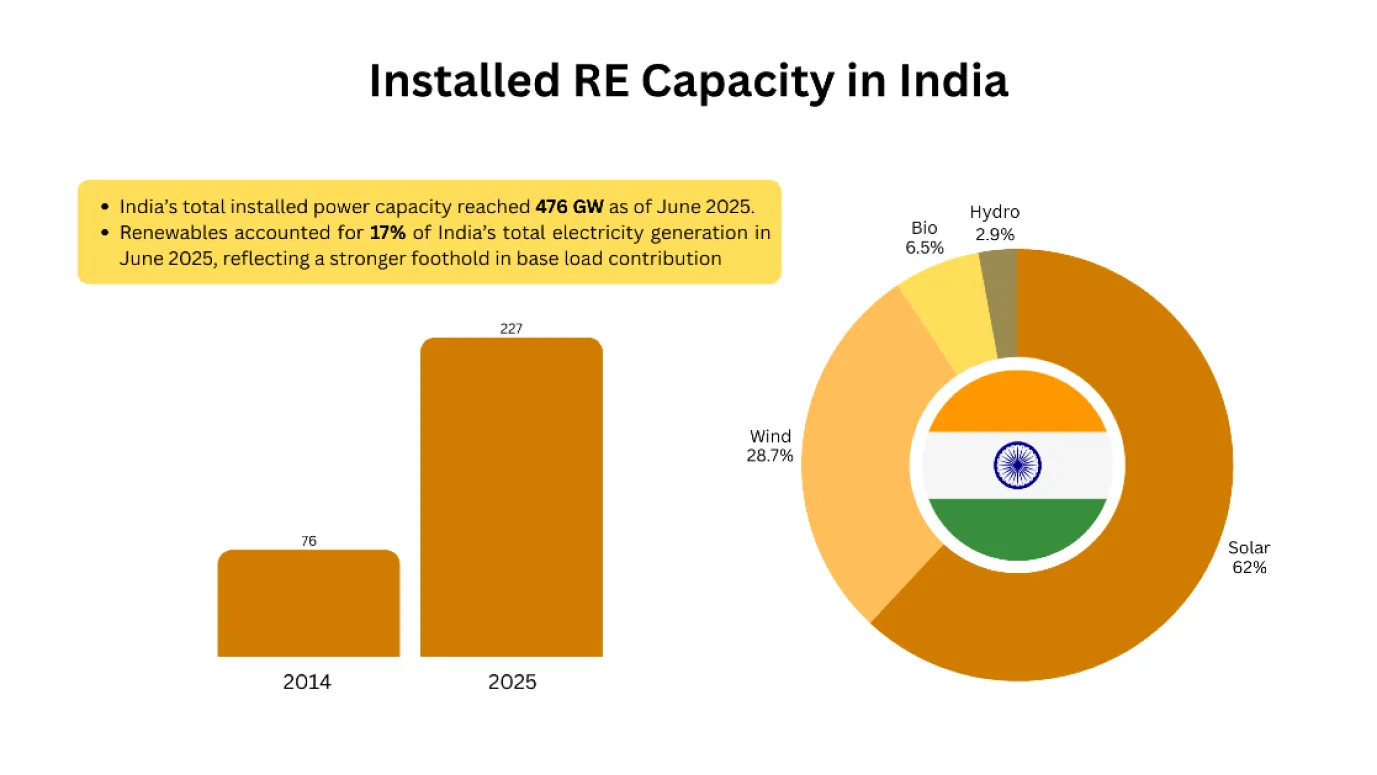
This surge is underpinned by policy support under the National Electricity Plan, aggressive RE auctions by the Solar Energy Corporation of India (SECI), and a growing pipeline of private sector investments. Renewable output increased by 24.4% year-on-year to 134.4 billion kWh in the first half of 2025, marking the fastest growth since 2022. Renewables accounted for 17% of India’s total electricity generation in June 2025, reflecting a stronger foothold in base load contribution. However, this rapid capacity growth is outpacing grid modernization and operational readiness, raising systemic concerns.
SECI’s June 2025 tender for 3.2 GW of solar-plus-storage projects, including a 2 GW solar farm with 4 GWh of battery storage, signals a necessary shift toward dispatchable renewables. This underscores that capacity alone does not ensure grid reliability without synchronized, storage-backed intelligence.
Yet, energy sector investment continues to lag. India mobilized just $13 billion in clean energy investments in 2024, compared to the estimated $68 billion per year required to stay on track with its 2030 targets. Overall, clean energy infrastructure will demand more than $300 billion by 2032, according to IEA estimates. Without corresponding investments in grid digitization, advanced analytics, and performance platforms, capacity additions risk becoming stranded assets.
What the Data Really Means
Capacity growth in isolation does not guarantee enhanced performance or resilience. As renewable projects become increasingly distributed and variable, grid complexity rises exponentially. Without robust real-time monitoring, the system becomes susceptible to congestion, intermittency, and asset-level underperformance.
The emphasis on storage integration in SECI’s tenders acknowledges this reality. Batteries are no longer optional; they are foundational to grid balancing and dispatch planning. However, without intelligent control layers, battery systems can underperform or degrade prematurely. Optimizing charge-discharge cycles and ensuring peak-aligned output require predictive analytics and orchestration platforms.
Additionally, the replacement of synchronous thermal generators with inverter-based renewable assets is eroding system inertia. This reduces the grid’s ability to manage frequency deviations, increasing the risk of cascading outages. India must now adopt synthetic inertia solutions, deploy grid-forming inverters, and build rapid response mechanisms into the control layer to mitigate this.
The grid is no longer a passive receiver of electrons; it is an intelligent, decentralized ecosystem. In this environment, operational intelligence, not installed capacity, determines resilience and performance.
What’s Holding India Back

Several operational bottlenecks continue to undermine India’s renewable ambition. First, fragmented asset visibility remains a chronic issue. Operators managing gigawatt-scale portfolios often rely on siloed SCADA systems with limited diagnostics. The absence of unified dashboards leads to delayed issue detection, suboptimal responses, and cumulative yield losses.
Second, despite the growth of renewables, coal still comprises 70% of India’s electricity generation. This reflects a confidence gap in RE stability and reliability. Much of this stems from poor O&M intelligence, reactive maintenance, and a lack of grid-responsive dispatch systems.
Third, many utility-scale battery deployments are not fully integrated with analytics systems. This diminishes their role in frequency control and tariff-optimized dispatch. Without predictive, state-of-charge forecasting and tariff-aware logic, these assets fail to realize their ROI potential.
Furthermore, most of the sector still relies on reactive maintenance models. This leads to increased downtime, unexpected outages, and elevated operating costs. Coupled with regulatory delays, DISCOM payment backlogs, and skilled labour shortages, the operational foundation of India’s renewable ecosystem remains fragile.
Apollo Energy Analytics in Action
Apollo Energy Analytics bridges this critical operational gap through a unified platform that leverages digital twins, AI-driven forecasting, and real-time diagnostics. The system is purpose-built to enhance performance across solar, wind, and battery energy storage systems (BESS).

Apollo’s asset intelligence suite offers real-time monitoring at the inverter level, enabling early fault detection and yield deviation tracking. Integrated weather and irradiance modelling simulates optimal performance, guiding swift and effective interventions.
Dr. Keyur Gandhi, Co-founder of Apollo Energy Analytics, states, “The clean energy sector is no longer constrained by how much capacity we can build; it’s constrained by how intelligently we can operate what we’ve already built. Apollo was designed to close that gap.”
Apollo’s predictive maintenance capabilities rely on machine learning models trained on historical and real-time sensor data. This allows asset managers to pre-empt failures, optimize spare part procurement, and reduce reactive truck rolls, resulting in better uptime and lower O&M costs.
For battery storage, Apollo provides advanced dispatch algorithms that forecast demand curves, tariff windows, and battery health metrics. This ensures that BESS assets are utilized in a manner that aligns with grid needs, while protecting battery longevity and maximizing energy arbitrage opportunities.
In addition, Apollo’s grid-inertia aware algorithms support dynamic voltage and frequency regulation, critical as India’s grid decarbonizes. The platform also integrates seamlessly with SCADA, EMS, and DISCOM-level data systems, simplifying reporting and compliance.
As Dr. Keyur notes, “Grid resilience isn’t just about building more, it’s about building smarter. At Apollo, we help stakeholders achieve that by transforming data into decisions, and decisions into yield.”
India’s target of 500 GW of non-fossil capacity by 2030 cannot be achieved through capacity alone. Operational intelligence will be the differentiator. Apollo Energy Analytics enables this transition, transforming potential into performance and ambition into action.
Ready to Lead the Smart Solar Revolution?

Apollo offers:
- Predictive yield forecasting to reduce downtime by up to 30 percent
- AI-powered analysis with patented digital twin technology
- Curtailment risk maps with integrated storage modeling
- iOS and Android compatible mobile app
Write to us at contact@apolloenergyinsights.com and let us future-proof your solar portfolio with data, not just ambition. If you’re looking to optimize your solar O&M, integrate predictive analytics, or navigate renewable energy policy changes, Apollo has the tools to lead the way.



Leave a Reply